
 Hardware
S0 IoT Gateway
Swiss knife for wireless IoT - Modular multi-protocol IoT gateway
S0 IoT Gateway
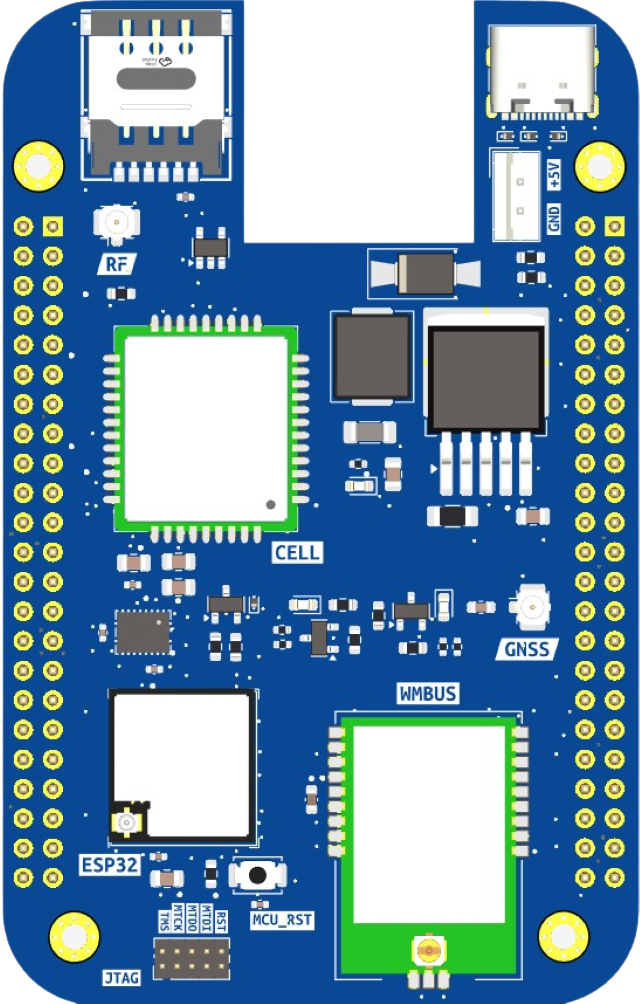
The S0 IoT Gateway is a robust and modular IoT Gateway for smart metering applications. Built around the ESP32-C6 microcontroller with a RISC-V core, it runs Zephyr RTOS and supports both Wireless M-Bus (wMBus) and wired M-Bus utility meters, transmitting collected data securely to Magistrala.
S0 = S0 Board + Baseboard — Zephyr RTOS
Looking for a Linux-based gateway? See the S1 Gateway, which combines the S0 Board with BeagleV-Fire.
Overview
S0 collects data from multiple wireless protocols and transmits it securely to the cloud. It integrates with Magistrala, a modern, scalable, open-source IoT platform.
Hardware Architecture
Core Components
| Component | Description |
|---|---|
| ESP32-C6 | Main microcontroller (RISC-V, WiFi, BLE) |
| RC-S2LP | Wireless M-Bus 868 MHz transceiver |
| SIM7080G | NB-IoT/LTE-M module |
| Ethernet | (Optional) local network through S0 Baseboard |
| USB-C & Terminals | For power and debug |
| GNSS Support | Optional via SIM7080G for asset tracking |
The board is compact and optimized for IP-rated DIN-rail enclosures for industrial/outdoor environments. It features side-mounted IPEX connectors for each antenna (WiFi, GNSS, NB-IoT, wMBus).
Connectivity Options
- Receive Data: WiFi, BLE, M-Bus, wM-Bus, I2C, SPI, UART
- Transmit Data: NB-IoT, LTE-M, WiFi, Ethernet (via Base Board), 4G/5G
Power Management
The S0 board can be powered in 3 ways:
- USB-C: For development and testing
- Power JST: Battery of maximum 7.4V connected via the battery JST connector
- Baseboard: The Baseboard supplies both 5V and 3.3V to the S0 board
Wireless Communication
-
WiFi/BLE: The ESP32-C6 provides 2.4GHz Wi-Fi and BLE. An IPEX connector on the ESP32-C6 accepts a 2.4GHz antenna of your choice.
-
Wireless M-Bus: The RC-S2LP module enables wireless M-Bus communication with wMBus meters at 868 MHz. An IPEX connector accepts a 868 MHz antenna.
-
NB-IoT / LTE-M: The SIM7080G module provides NB-IoT/LTE-M connectivity. Two IPEX connectors handle RF (wireless) and GNSS (GPS) antennas. The SIM7080G is controlled via AT commands from the ESP32.
Firmware and Flashing
The S0 board uses the ESP32-C6 as its main microcontroller and can be programmed using any framework of your choice. Firmware is flashed through the USB-C connector.
Debug is possible via the USB-C connector or the JTAG pins labelled on the board, enabling both on-site and off-site debugging.
Software Stack
Zephyr RTOS
S0 runs on Zephyr RTOS, providing:
- Secure and modular firmware stack
- Built-in protocol support (MQTT, CoAP, WebSockets, HTTP)
- Open-source foundation for transparency and maintainability
- Community-driven innovation
Magistrala Integration
Native integration with Magistrala IoT platform:
- Seamless data ingestion and device management
- Secure cloud connectivity
- Open-source and patent-free
- Scalable architecture
Software Features
The gateway firmware:
- Collects meter data periodically from both wired and wireless M-Bus meters
- Transmits structured data securely to Magistrala via MQTT
- Manages reconnections and retry logic for unreliable NB-IoT networks
- Logs diagnostics and status via UART or remote logging service
Supported communication protocols:
| Protocol | Security | Description |
|---|---|---|
| MQTT | No | Lightweight messaging protocol for IoT data exchange |
| MQTTS | Yes | Secure MQTT communication over TLS (mTLS supported) |
| CoAP | No | REST-based protocol optimized for constrained devices |
| CoAP DTLS | Yes | Secure CoAP communication using DTLS encryption |
| HTTP | No | Standard web communication protocol |
| HTTPS | Yes | Secure version of HTTP over TLS |
| WebSockets | Yes | Full-duplex communication protocol over TCP |
Expansion Options
Base Board
The S0 Base Board adds:
- W5500 Ethernet controller
- TSS721A M-Bus transceiver
- SD card slot for data logging
- 24V DC power input
- Battery backup with charging circuit
- DIN-rail mounting
Use Cases
Smart Metering
Deploy S0 for residential and industrial utility monitoring:
- Read wireless and wired M-Bus meters
- Backhaul via NB-IoT or LTE-M
- DIN-rail mount in electrical cabinets
- Battery backup for power outages
Industrial Predictive Maintenance
Monitor industrial machinery for anomaly detection:
- Collect high-frequency sensor data
- Real-time edge processing
- Local anomaly detection
- Reduced network usage
Edge AI Inference
Run AI inference at the edge:
- Privacy-preserving processing
- Low-latency decisions
- Independent of cloud connectivity
Agricultural IoT
Monitor remote farms and fields:
- Soil moisture and weather monitoring
- GNSS geo-tagging
- Offline SD card logging
- NB-IoT backhaul